Retail follows rooftops, and rooftops follow jobs. That order matters for every community working to attract new stores and restaurants, because the strongest retail recruitment story usually starts with an economic development win.
When a manufacturer expands, a distribution center breaks ground or a new neighborhood gets approved, retailers notice. The past few months delivered plenty of economic development wins in rural and mid-sized communities, and national brands are responding.
Big investments in smaller markets
Some of the largest economic development projects in the country are landing well outside major metros. In Starkville, Mississippi, home of Mississippi State, Southwire is adding about 380,000 square feet to its campus, a $256 million investment and the largest in the city’s history. In Franklin County, Georgia, Walmart is building a $1.3 billion, 1.5 million square foot fulfillment center in Carnesville that will bring 1,000 jobs. Macon, Georgia broke ground on a $125 million precision manufacturing and defense plant with 500 jobs in engineering, skilled trades and logistics.
Tennessee had a strong stretch as well. Columbia, south of Nashville, landed Medacta International’s U.S. headquarters and manufacturing hub, an $85 million project with more than 200 jobs, while county unemployment fell from 6.1% to 4.4% between April and June. Blount County, just south of Knoxville, drew a $43.6 million Siemens Healthineers expansion with more than 90 high-wage technical jobs. And in Rogers County, Oklahoma, northeast of Tulsa, a data center agreement will generate roughly $180.5 million in payments over 25 years, including $100 million for local schools and a $5 million community fund.
Each of these projects brings payroll, and payroll brings spending. That is the data point retailers want to see.
Communities planning ahead
Growth is also showing up in the planning pipeline. Harrisburg, South Dakota, just south of Sioux Falls, has grown from about 6,800 residents in 2020 to roughly 12,000 and secured an $8.3 million state loan to support more than 1,000 new single-family lots. Foley, Alabama, on the Gulf Coast, adopted a budget reflecting 70% population growth over ten years. Payson, Utah advanced a 1,046-acre growth plan with 181 acres set aside for commercial development, which city staff described as a way to keep local retail dollars from leaking to neighboring communities.
Downtowns are benefiting too. In Lake Wales, Florida, a $21 million apartment project will put 308 households within a five-minute walk of the downtown commercial district. That kind of density is exactly what supports restaurants, specialty shops and everyday retail.
Retailers are following the growth
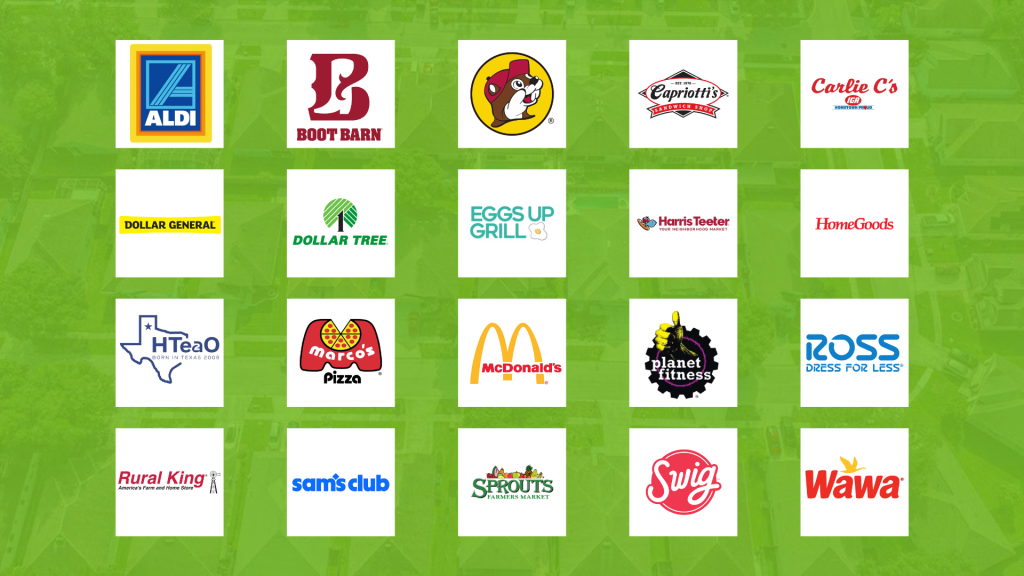
National brands continue to expand into these markets. Wawa set dates for its Middle Tennessee rollout as part of a plan for more than 50 Tennessee stores over the next decade. Swig signed 38 units across Missouri and Kansas, its largest Midwest commitment so far. Planet Fitness opened new development agreements to franchisees for the first time in more than a decade, and its development leadership said the company is re-scoring markets that used to be off the list.
Grocery and value retail remain especially active. Sprouts is on pace for more than 40 openings this year, Aldi is still on track for 180 new stores, and Dollar General and Dollar Tree both reported same-store sales gains above 3%. Buc-ee’s opened its first Arkansas location in Benton. Eggs Up Grill, HTeaO, Boot Barn, Ross, Marco’s Pizza and Capriotti’s are among the many other brands adding units in small and mid-sized communities.
Not every retailer is shrinking its requirements, and that’s worth knowing too. Rural King, which operates 150 stores across 17 states and adds about 15 a year, looks for 70,000 square feet or 10 acres, buys rather than leases, and wants a 50,000-person trade area. The company has said it will pursue new construction only where meaningful incentives are available. For communities that fit the profile, that makes local economic development tools a real part of the conversation.
Wins on the ground
The results are showing up in the communities we work with. HomeGoods opened its first store in Albany, Georgia and welcomed more than 2,300 shoppers before 3 p.m. on opening day. Sam’s Club opened a new-format store in Lebanon, Tennessee.
In Albemarle, North Carolina, the city approved a performance grant to bring Carlie C’s, a family-owned grocer, into a vacant 32,000 square foot former Harris Teeter, projected to generate $10 million a year in taxable sales. Guthrie, Oklahoma opened a McDonald’s after a 55-day build, which the company called its fastest anywhere in the world, a strong example of what streamlined permitting can do. And in Ripley, Mississippi, Ripley Main Street launched an artisan accelerator inside a long-vacant historic downtown building.
We’re also glad to welcome East Moline, Illinois, in the Quad Cities, which recently selected Retail Strategies for retail recruitment. The city is focused on The Bend, the 12th Avenue corridor, downtown and the Avenue of the Cities.
What this means for your community
Economic development and retail recruitment work best together. New jobs, housing and infrastructure create the demand retailers need to see, and the right recruitment strategy turns that demand into new stores, restaurants and sales tax revenue. If your community is growing, let’s talk about how to put that story in front of the brands that are expanding right now.
What does your market look like?
Request a market pulse report and start building a retail-ready future for your community.